
Siri AI vs Alexa+: personal devices or household help?
Siri AI is the more direct fit for eligible Apple devices and personal app context; Alexa+ emphasizes connected household services and Amazon account personalization. This comparison uses official documentation reviewed November 6, 2026, separating current availability, announced capabilities, developer previews, privacy controls and the checks needed before choosing.
Choose around the work you actually need
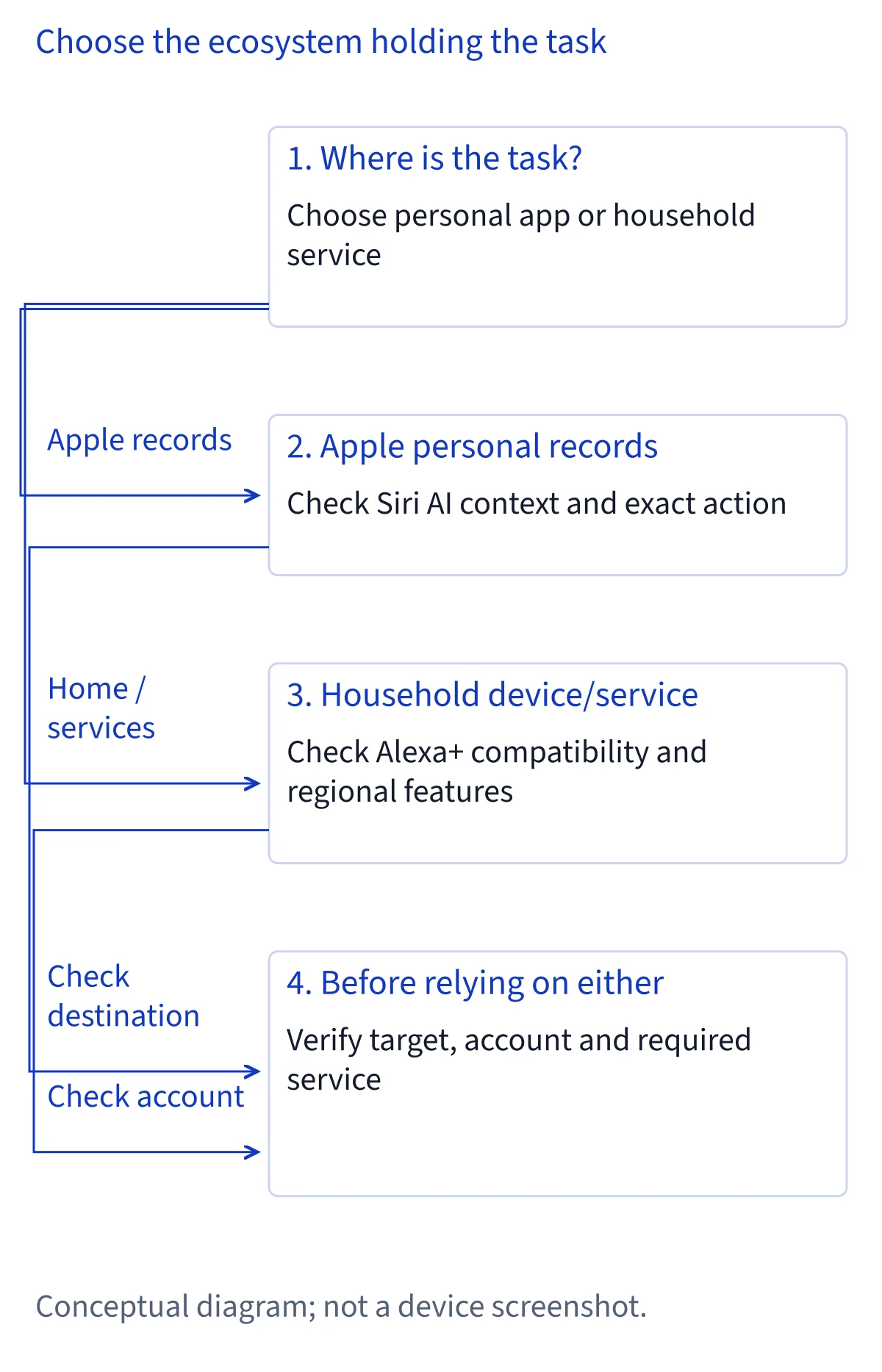
The most useful distinction is where your information and everyday actions already live. Apple's setup article describes Siri AI finding personal context across messages, email, photos and other apps, answering questions about the screen, and carrying out app actions. Amazon's Alexa+ announcement emphasizes household control, entertainment, shopping and connected services. These are overlapping priorities rather than exclusive categories: Amazon also offers mobile and browser access, while Apple describes capabilities beyond a phone.
As a decision method, identify three recurring tasks and the accounts, devices and permissions each requires. Someone primarily retrieving personal information on an eligible Mac has a different starting point from a household coordinating speakers, lighting and food delivery. This is practical advice, not a claim that either product has won a comparative test.
Then distinguish the ability to discuss a task from permission and technical support to complete it. A conversational answer about a reservation is not evidence that the assistant can book your restaurant, use your account or complete the transaction in your country. Evaluate the required action and its availability separately.
Read availability claims with their dates attached
The relevant Amazon announcement was originally published February 26, 2025, and explicitly updated July 21, 2026. Its reviewed text says Alexa+ is available to all customers in the United States and Canada, with early access in Brazil, the United Kingdom, Mexico, Italy, Spain, Germany, Austria and France. It also warns that features vary by region. Those distinctions matter more than treating the original launch announcement as a permanent description of an early rollout.
Apple's consumer setup article, published November 5, 2026, describes Siri AI as a beta across supported OS 27 platforms. Apple's separate November 3 developer announcement introduces third-party integration previews in the 27.3 betas. A consumer setup page and a developer preview announcement describe different layers of availability; neither should erase the conditions in the other.
For a purchasing decision, read the product, platform, market and feature together. An account gaining access to Alexa+ does not establish every partner service locally. Likewise, an Apple device offering Siri AI does not prove that every third-party app has shipped its new integration.
Check the exact device and access surface
Apple's setup article lists iPhone 15 Pro models, iPhone 16 models or later, iPhone Duo and iPhone Air; supported iPads include mini models with A17 Pro or A20 Pro and iPads with M1 or later. Mac eligibility includes M1 or later and MacBook Neo with A18 Pro. Any Apple Vision Pro is listed. These are hardware conditions alongside the relevant operating system, language and account requirements, not a promise that an older Apple device becomes eligible through an app installation.
The same article lists Apple Watch Series 9 or later, Ultra 2 or later, and SE 3, paired with an Apple Intelligence-enabled iPhone with Siri AI enabled. Do not interpret that pairing condition as a guarantee that every watch action operates independently.
Amazon's announcement describes Alexa+ access through Echo devices, the Alexa mobile app and Alexa.com, with additional experiences on Fire TV and Amazon Music. It is not a complete compatibility list for every older model. Before buying equipment, check the exact model and feature; mobile access alone does not establish identical household controls.
Compare the documented subscription terms
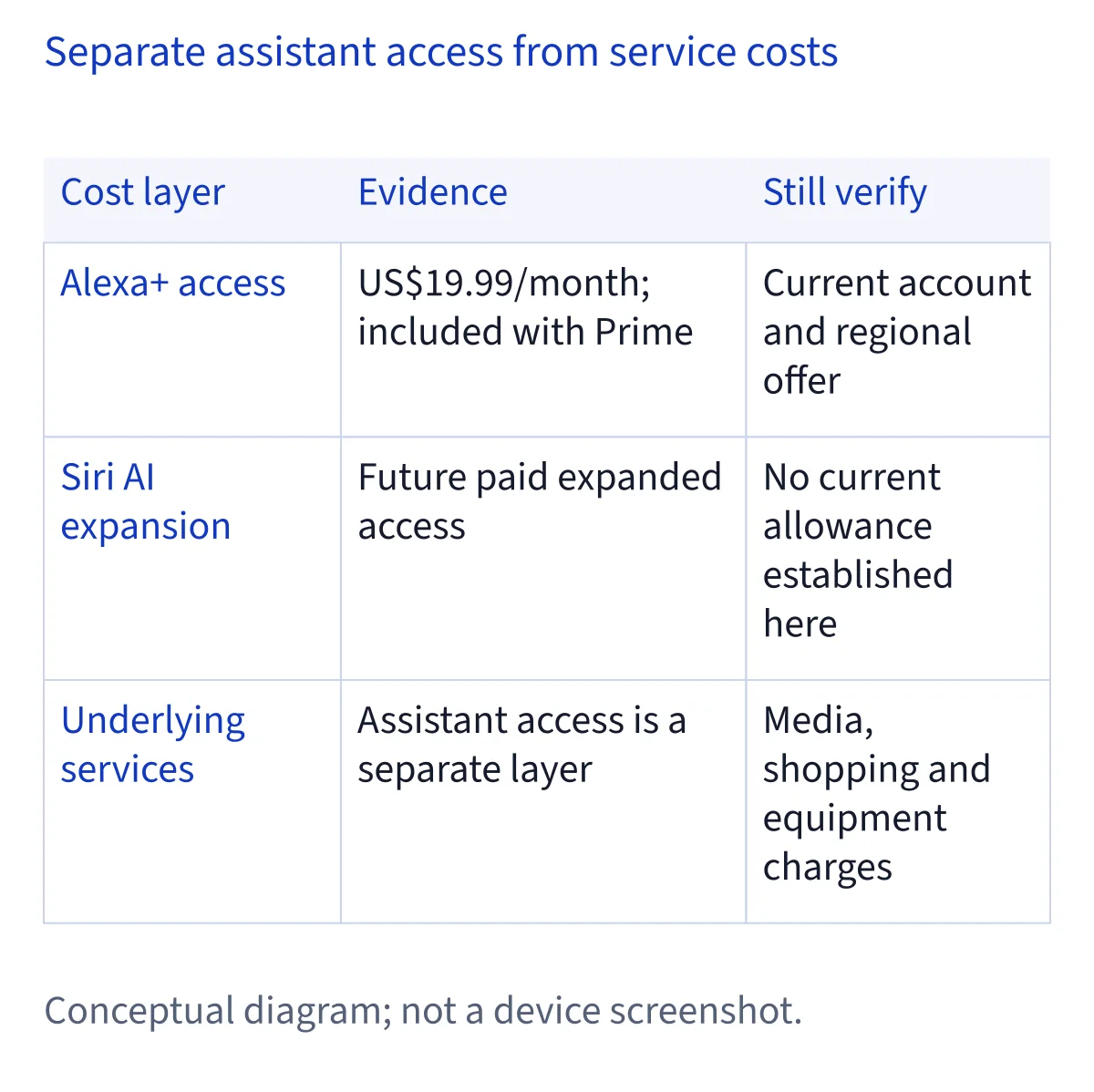
Amazon's reviewed announcement quotes Alexa+ at US$19.99 per month and says it is included for Amazon Prime members. Treat those figures as the terms stated in that announcement, not as verified local pricing for every country or early-access program. The article's regional availability statement does not supply a separate price and membership interpretation for each market. Check the offer attached to your account before starting or changing a subscription.
Apple's setup article does not announce a matching monthly Siri AI subscription price. It does say that certain server-model features have daily usage limits and that expanded access will be offered for a fee in the future. It gives no fixed allowance, purchase date or current paid tier that supports a precise subscription comparison.
Budget for the underlying services and equipment
Assistant access and the underlying service are separate expenses. A subscription statement does not establish that groceries, restaurant charges, delivery, media subscriptions or connected equipment are included. For budgeting, compare the account access you already have, any necessary hardware, and the services your intended tasks actually consume, rather than calculating savings from unsupported assumptions.
Match personal context to the right information
Apple's setup article describes personal context across Messages, Mail, Calendar, Notes, Reminders and other information. Its developer announcement also describes onscreen awareness and access to app content through supported integration mechanisms. The useful question is therefore whether the information you need is available to Siri under the relevant app and privacy settings, rather than whether the assistant can produce a plausible answer about your day.
Amazon describes personalization using Amazon purchases, listening and viewing activity, delivery information and payment preferences. Its announcement also says customers can supply documents, email, photos and messages for Alexa+ to summarize, remember or act on. Supplying material through those channels is a different information path from Apple's description of context across device apps.
As practical advice, begin with a narrow, non-sensitive task and verify the underlying information yourself before relying on the result. Avoid uploading an entire document collection merely to answer one question. For shared households, decide which information should be available through shared equipment and which should remain associated with an individual's device or account.
Evaluate household actions and app workflows separately
Amazon's announcement names smart-home products and services including Philips Hue and Roborock, entertainment providers, and voice-created Routines combining actions such as lighting, music and weather. It also describes moving entertainment between household endpoints. These are Amazon's documented product descriptions, not evidence that every accessory, subscription or room configuration has been independently checked. Confirm the exact integration before replacing an existing home control arrangement.
Apple's November 3 developer article names a rollout across Calendar, Files, Finder, Journal, Mail, Maps, Messages, Music, Notes, Photos, Preview, Reminders, Safari, Shortcuts and Weather. It gives examples such as finding a previously visited coffee shop and archiving files not opened for over a year. The document describes an Apple-announced rollout; it does not establish every action on every platform.
The distinction helps prevent an unfair comparison. A household routine and an action inside a personal app solve different problems. Identify the required trigger, destination and permission, then check support for that chain. The Siri AI device list also does not establish HomePod eligibility, so do not infer an equivalent speaker deployment from Apple's broader ecosystem.
Treat bookings and purchases as consequential actions
Amazon's updated announcement names OpenTable and Vagaro for reservations or appointments, Amazon Fresh and Whole Foods Market for groceries, and Grubhub and Uber Eats for delivery. It also includes a forward-looking example of arranging an oven repair through Thumbtack. Preserve that difference in wording: an example described as something Alexa+ will be able to do is not proof of a universally available booking flow today.
Apple's developer announcement uses bookings and orders as examples of actions developers can build through the new preview. That does not confirm a public Siri AI integration from a particular restaurant, delivery company or booking platform. The service provider needs its own supporting documentation before such a claim is dependable.
Neither supplied announcement establishes a universal rule that every purchase or booking always requires a final user confirmation. Do not assume that safeguard. As advice, inspect the relevant service's authorization, purchase controls, confirmation process and cancellation terms before enabling transactions. Review the merchant, amount, date, address and recipient before authorizing an action, and verify completion in the provider's own account records.
Follow the data path rather than a privacy slogan
Apple's Siri, Dictation & Privacy notice distinguishes several processing paths. With Siri AI enabled, requests may be processed on the device or sent to Private Cloud Compute. Apple says data processed there is not retained or made accessible to Apple. That statement concerns Private Cloud Compute processing; it does not mean every related search, interaction record or third-party service follows the same rules.
The same notice says some Search requests are sent to Apple, stored and used to improve Search, Siri and related features. It separately discusses optional improvement programs and request-related data. Apple's notice also says third-party interactions are subject to the other provider's terms and privacy policy. A privacy comparison must keep these categories separate.
Amazon describes Alexa+ as built on AWS infrastructure and says the Alexa Privacy dashboard centralizes interactions and settings. The supplied announcement does not specify complete retention periods or every downstream service's handling. Consequently, it supports identifying the dashboard as a review point, but not inventing a deletion deadline or claiming that all Alexa+ information stays within a speaker.
Review controls for individuals and shared spaces
Apple's privacy notice documents controls for excluding apps from Siri, disabling optional improvement programs, limiting location access and changing iCloud synchronization. For the supplied English interface wording, Excluded Apps is the relevant control for stopping Siri from using specified apps' information or taking actions within them. The notice also distinguishes Help Apple Improve Search from Improve Siri & Dictation or Improve Siri & Apple Intelligence; changing one setting should not be described as switching off every collection path.
For Alexa+, Amazon's announcement directs customers to the Alexa Privacy dashboard for interactions and settings. Use that as the starting point, then consult the account's actual controls and any connected service documentation. The announcement alone does not establish a particular retention selection, deletion scope or household isolation guarantee.
As a practical household policy, agree who can connect accounts, share documents and authorize transactions. Review permissions again when a device changes owners or a household member leaves. These are recommended precautions, not claims that voice recognition, a shared speaker or a personal phone automatically provides complete separation between people's information.
Check language, region and account together
Apple's setup article lists English, French, Japanese, Korean, Portuguese and Spanish, with the device and Siri set to the same supported language. It says Siri AI is unavailable on iOS, iPadOS and watchOS in the European Union, while eligible macOS and visionOS configurations can use it with an EU Apple Account and matching supported languages. It also says Siri AI currently does not work with a mainland China Apple Account region. Spanish language support therefore does not establish iPhone availability in Spain.
Apple's developer announcement describes Traditional Chinese, Norwegian, Turkish and Vietnamese as coming soon. They should not be presented as already generally supported within this documentation snapshot. Likewise, expressive voices have their own English-only and narrower hardware conditions, separate from basic Siri AI eligibility.
Amazon's announcement lists countries and regional variation, but it does not provide a complete language matrix for every device and feature. Early access in Spain or Mexico should not be expanded into a guarantee for every Spanish dialect, account configuration or partner integration. Consult the local offer rather than recommending account-region changes as a workaround.
Plan for connectivity and variable usage limits
Neither set of supplied sources supports a blanket offline guarantee. Apple's privacy notice describes both device processing and server routes, including requests that obtain current information. Amazon's announcement describes cloud infrastructure and connected services. An assistant having some local processing does not establish that a particular personal-context query, reservation or household sequence will finish without connectivity. For important tasks, retain an accessible manual route through the relevant app or service.
Apple also documents variable daily limits for certain server-model features, depending on the feature, request complexity, demand and policy. It does not provide a universal numeric allowance. Its setup article says automatic downloads may involve a waitlist during high demand, without promising a fixed wait.
Check integration maturity separately
Integration maturity is another separate constraint. Apple's 27.3 third-party Developer Preview is not general public availability for every participating app. Existing Shortcuts support is also not proof of a newly shipped Siri AI integration. On Amazon's side, partner names in an announcement still need the region, account and supported task checked. Troubleshoot access, permissions and integration status separately from conversational quality.
Coexist without assuming shared memory
Using both assistants can be reasonable when personal Apple workflows and household Amazon services meet different needs. Apple's setup article describes conversation history synchronized through iCloud across eligible Apple devices. Its privacy notice says Siri app history synchronized through iCloud uses end-to-end encryption. Amazon separately describes carrying conversation context across its own supported endpoints. Neither statement establishes a shared conversation store between Siri AI and Alexa+.
A connected calendar or service account should not be treated as evidence that the assistants exchange memories, permissions or pending tasks. As a practical arrangement, assign ownership of recurring activities: for example, choose one place to maintain household reminders and verify changes in that underlying service. This is suggested organization, not an official cross-assistant workflow or a claim of tested synchronization.
Choose Siri AI when your priority is supported Apple devices and their documented personal app context. Choose Alexa+ when the relevant household equipment and service integrations fit your actual account and market. Keeping both is also a valid outcome. Base the decision on confirmed access, manageable permissions and tasks you can verify, rather than a promise that one assistant replaces every other interface.
Common questions
Does Amazon Prime include Alexa+ everywhere?
Amazon's announcement, updated July 21, 2026, states that Alexa+ costs US$19.99 monthly and is included for Prime members. It separately identifies general availability and early-access markets. That does not establish identical local prices, membership conditions or features everywhere. Check the offer shown for your country and account before relying on Prime inclusion.
Can I use Siri AI in Spanish on an iPhone in Spain?
Spanish is a supported Siri AI language, but language support does not override regional restrictions. Apple's November 5 setup article says Siri AI is unavailable on iOS, iPadOS and watchOS in the EU. It separately permits eligible macOS and visionOS configurations with an EU account and matching supported device and Siri languages.
Will Siri AI and Alexa+ share my conversations?
The supplied documentation does not establish shared conversation memory between them. Apple describes Siri history synchronized through iCloud across its devices; Amazon describes continuity across Alexa+ endpoints. Those are separate systems. Even if both connect to the same calendar or service, do not assume they share dialogue, permissions, pending actions or deletion settings.
Do bookings and purchases always ask for confirmation?
Neither supplied announcement documents a universal final-confirmation requirement for every transaction. Amazon names booking and shopping services; Apple describes actions developers can build in a preview. Before enabling transactions, review the specific provider's authorization and purchase controls. Check the merchant, amount and booking details, then verify completion directly with that provider.